
8 Reasons Why You May Need A Crown
And why they’re one of the easiest dental procedures for patients.
You deserve a crown!
(A dental crown, that is.)
A dental crown is a tooth-shaped cover that is placed over a broken/cracked tooth or to fix a large cavity when a filling will no longer suffice. It makes a tooth strong and healthy again and will hopefully protect your natural tooth for many years.
Read on to learn about crowns and the top 8 reasons why you may need one.
Dental crowns allow you to keep your own teeth.
I'm sure you want to keep your natural teeth and a crown is one of the most common restorations to help you to do just that. Technology for crowns has come a long way. It is typically a pain-free procedure with little to no recovery time. Here at Riverbend Dentistry, we reserve special appointment times for crowns so they are available usually within a few days... because if your tooth breaks, treatment can't wait very long. Saving a tooth with a crown can help you to avoid extractions and then possibly an implant/bridge/or a partial denture.

Photo courtesy of oral answers
Did you know our crowns are hand-painted?
Yep, by dental lab technicians, who we trust dearly! Each permanent crown is custom-made just for you. Crowns are provided in two appointments: at the first appointment we will "prep" the tooth and place a temporary crown, the second appointment a few weeks later is when you'll receive your permanent crown.
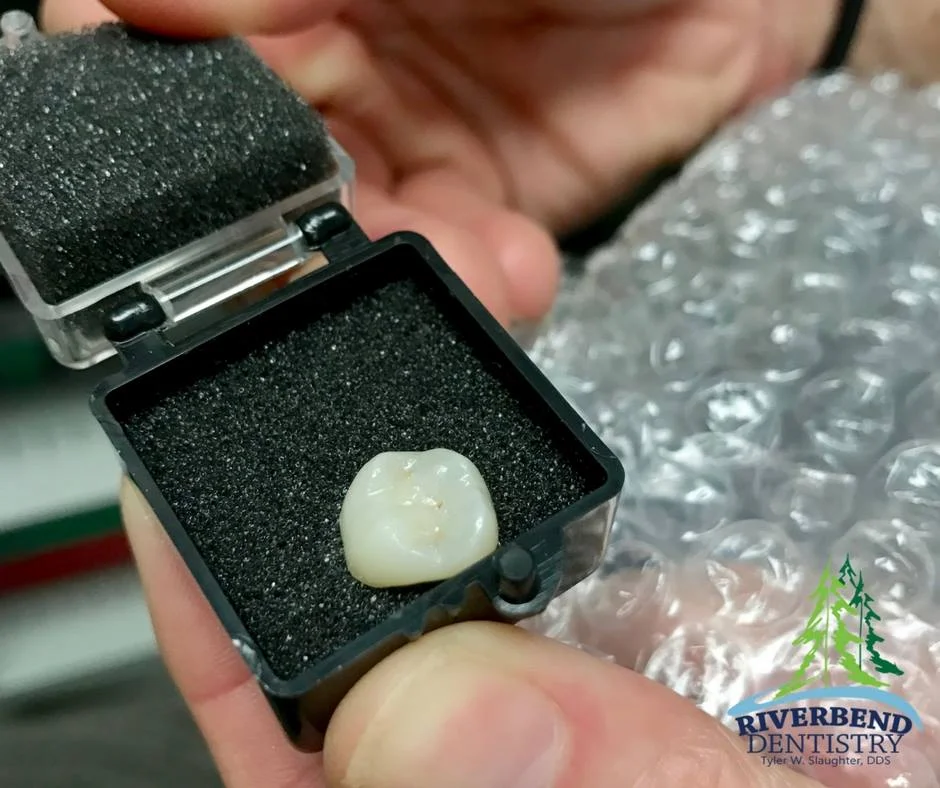
The 8 most common reasons that you may need a dental crown are:
• To cover and protect a tooth that has been weakened, usually due to decay.
• To stabilize sections of a cracked tooth.
• For broken tooth repair.
• To repair a tooth that has been severely worn down.
• To cover and strengthen a tooth where there is a large filling and very little tooth structure remaining.
• To reinforce a tooth that has had a root canal.
• To anchor a dental bridge in place (or finish a dental implant).
• To repair misshaped or severely discolored teeth.
Dental Insurance Hack: Crowns are typically covered at 50% (rarely 80%) on most dental plans up to your annual maximum and after your deductible. Be aware, many plans require the patient to have the insurance for at least a year for "major" coverage, which includes crowns!
Dr. Slaughter does PHENOMENAL crown work! (From one crown, to over ten!)

A multiple crown case by Dr. Slaughter:
If you KNOW you need that crown, or you suspect you might, give our Treatment Coordinator, Amanda, a call today: 573.635.6080
Until I need my next dental crown (I'm two in),
I'll dream about floral crowns instead.

-kim
DISCLAIMER: You should always call your insurance company or HR representative to find out the details of your insurance policy.
![Insurance 101: How Does Dental Insurance Work? [The $1,000 maximum]](https://images.squarespace-cdn.com/content/v1/5a678f3849fc2b39f2ceea93/1535475608798-H18SW91ICA9RK2KFB0YK/blog+-+welcome%281%29.png)
Insurance 101: How Does Dental Insurance Work? [The $1,000 maximum]
Let’s start at the beginning. Get ready for some shocking information!
Whether you're new to our practice or have been a valued patient for years, you may have questions about your dental insurance. This is the first post in a series covering many aspects of dental insurance--today, I'll blow your mind with where it all began and what it is like in 2018. I guarantee you'll learn something! (And maybe even get a little upset.)
Most dental benefit plans are offered thanks to a contract between your employer and an insurance company/union/association. Some person with your employer negotiates the terms of your insurance plan and they make the final decision on maximum levels of reimbursement and other details of your policy.
Unlike medical insurance, which started pre-1900...
Dental insurance is relatively new.
The concept of dental insurance was started in the 1950s and was widely available by the '70s. Most plans at that time were offered by who else but Delta Dental!
Even back then, dental insurance plan basics were typically:
$1,000 maximum, $50 deductible, 100% preventative covered, 80% coverage for basic (ex-fillings), 50% coverage for major (ex-crowns)
Guess what we have today, decades later? Copy and paste from above. No, really, it's the same for most patients with today's dental insurance.
Can you believe that dental insurance coverage amounts haven't changed much in over four decades, if not longer?
$1,000 in 1970 should give you the purchasing power of OVER $6,000 in 2017 dollars! $1,000 back then definitely would cover all dental care needed by most people, which is not the story in 2018. (Dental offices are even encouraged to call your benefits a "deposit" and not your "insurance", for this reason.)
It is documented that maximum levels of dental insurance have typically not increased at the rate of inflation since the late 1960s! Premiums (monthly fees to have insurance) keep going up for you and your employer but your coverage is stagnant or even worse with increasing restrictions by the insurance companies. Shocking, no?
"Are you in-network with our insurance company?"
This is probably one of the most common questions we receive via email or phone. "In-network" means a dental office is contracted with an insurance company and thus required to discount their fees. (Learn more about dental insurance terminology in our next Insurance 101 post!)
Newer insurance plans are offering lower and lower fees to contracted dentists so many dentists have to drop that contract--unable to run a business, take care of employees, support their communities, and more with low reimbursement. Low reimbursement means some dental offices often have to see many more patients to make ends meet.
Choosing your dental care provider shouldn't be dictated by your insurance company.
The great thing is that for most patients with dental insurance, you don't have to stay "in-network"! (Call your HR representative or insurance company to make sure you have out-of-network benefits.) Most of our patients with insurance are out-of-network. Dental offices who are out-of-network COULD ask patients to pay in full at the time of service and be reimbursed directly by their insurance company. We don't require that! We will ask for your estimated deductible and coinsurance at the time of service, send the rest to insurance to see what shakes out; if there is a balance we will send a statement. [To see who we are in-network with, click here or give us a call: 573.635.6080.]
I KNOW you learned something today! If you are fired up to make changes, we encourage you to speak with your employer or their HR department. There are many insurance companies and even plans within the same insurance company to choose from! If you are thanking your lucky starrs for a generous dental insurance plan--be sure to thank your employer today!
In the mean time, here's a little 1960s/70s wallpaper to help take us back to a time where $6,000+ in dentistry coverage was a real thing:

If you decide your dental insurance isn't meeting your needs and you'd like to consider another option, we have a great Dental Wellness Membership program. It isn't insurance and you are not eligible if you have dental insurance, but it can help you to get the care you need today without maximums and other restrictions.
Peace out!
Coming up next in the Dental Insurance 101 series: understanding your explanation of benefits and basic insurance terminology!
DISCLAIMER: If you have questions about your dental insurance plan, we recommend you always contact your insurance provider or your human resources department.