
So you want whiter teeth-- we have the tips, tricks, and tried and true
And our top 10 tips to whiten your natural teeth!

We hear you—
You want whiter teeth.
Whether in the dental chair or meeting a Riverbend team member out and about, we often hear the age-old question, “How do I get whiter teeth?” Read below on how to whiten your natural teeth including our top tips! (And what to do if you’re still not satisfied after whitening!)
Why tooth color matters:
And whether you like it or not, tooth color matters (specifically in the United States). I’d argue, way more than how straight your teeth are or if you have that gap you hate… tooth health and thus overall health is often graded by the public on their shade. It isn’t fair and usually isn’t even accurate.
To most people, they want whiter teeth to make them look younger, healthier, more attractive. To give them confidence at work or on the dating scene. Just because they believe it will make them happier. Whatever the reason—
If you’re in this boat, there’s a few things you can do to help get the smile of your dreams.
First, you must get a cleaning and exam with x-ray images.
Don’t put the cart in front of the horse—-you can’t whiten plaque built up on your teeth, plus, regular cleaning will whiten your teeth anyway. With mini power washers, your registered dental hygienist can do WONDERS with blasting away surface stains. Help yourself get on the right track and be sure to get your teeth cleaned at least twice a year (more if you have braces, diabetes, or are managing gum disease.)
Fixing any decay is usually going to be your first goal, but if some decay is in the front of your mouth, be sure to discuss whitening with us—we will strategize if you actually need to whiten before fixing the decay (otherwise, the filling will match your old, yellow-er teeth.)
Whitening vs. brightening (in-office vs. at-home):
We often say in-office will whiten while at-home will “brighten”.
It’s no question that in-office professional whitening will give you the biggest, most noticeable effect. We can offer stronger products you can’t just buy over-the-counter or online. We also take steps to ensure your gums don’t get “burned” and other precautions to help with general sensitivity.
For in-office whitening, PLAN AHEAD.
These 90 minute appointments are booked well in advance and “squeezing it in” before your cousin gets married next week probably won’t happen.

Example of teeth whitening strips.
Short on time or money? Give at-home products a spin!
Over-the-counter or online options DO work, they will just take longer and therefore you’ll often experience more sensitivity.
Not all at-home products are made equal: White strips may LOOK the same, but did you know you can buy stronger ones at dental offices? We offer two kinds—my personal favorite for strips are the professional Crest 3-D Advantage. It’s a two week treatment (although you can always do less and take a break) and they are very textured! They stick a lot better than others we’ve tried.
Strips aren’t your only at-home solution! Whitening toothpastes don’t hurt to try (don’t expect shocking results).
We also offer GLO at-home whitening vials (you quickly paint it on your teeth) or the GLO at-home whitening system (see image below)! At just 8 minutes at a time, everyone can have time for whiter teeth. See more about how it works here: https://www.youtube.com/watch?v=X4uc73GEUKc The GLO at-home system is similar in style as the professional in-office, but the strength of the whitening gel will of course be higher in-office.

How fancy you can look with your GLO at-home whitening.
You can also get over-the-counter or professional whitening trays to fill with product (and usually sleep in); these aren’t our favorite but we do offer gel refills if needed!
So at-home or in-office, which is right for you?
Many people try at-home and realize they want MORE so then they schedule in-office. Others don’t want to do the at-home, lengthier treatments and they just want whiter teeth RIGHT NOW. As mentioned, if you truly want whiter teeth and not just brighter, you will most likely need in-office services then you can just maintain with at-home products.
Learn more about our cosmetic services here!
Remember, if you have filling material, crowns, or veneers, you cannot whiten them with any of these products, but we can definitely provide a treatment plan to get you the smile of your dreams!
The “natural” question:
Charcoal powders, baking soda, oil pulling, etc…. most of these shouldn’t HURT you in any way, but you just need to keep your expectations low. Google away, use common sense, then call us later if you want a better result. ;) (Sometimes, safe chemicals are just necessary to get the outcome you desire.)
What about sensitivity?
If you have gum disease, are a hard brusher, or experience generalized tooth sensitivity already—you definitely want to take precautions to help and know that it may still create some soreness. GLO Professional In-Office whitening boasts to have some of the lowest sensitivity on the market (which is why we offer it), but there is never a guarantee it will be pain-free :( …you can be prepared! Talk to your healthcare professional about whitening and any sensitivity you have already; they may recommend some specialized products.
Pro tips:
Buy a sensitivity toothpaste and use it daily for at least a couple of weeks before whitening. It takes a couple of weeks to achieve the maximum benefit but these toothpastes usually do not fight cavities—we recommend using it once a day and a traditional toothpaste for your second brushing. The second part of this tip is to NOT RINSE! You want that to soak in so just spit it out as best as you can. This takes some getting used to, we know!
After whitening if you are a little sore or experience “zingers” (totally normal), you can take any over-the-counter pain medication that you’re comfortable with.
Take an anti-inflammatory pain medicine, like Ibuprofen, BEFORE your professional whitening appointment!
How much does it cost?
In-office whitening will generally run $300-500+ if you dig around online. At-home products like professional grade whitening strips will be under $100. The question is—how white/bright and how soon?
We try to offer GLO whitening products as affordably as possible. GOOD in-office whitening is not going to be available cheaply (for the love of goodness, do not do the mall kiosk whitening.)
If professional whitening is what you want, did you know CareCredit can offer zero-interest financing for those who qualify? It’s true! Cassie, our Treatment Coordinator, can even help you to apply.
Riverbend Dental Wellness Members receive promo pricing on professional whitening at any time!
Long story short—here are our top tips for whitening natural teeth!

Bonus tip: Pick the right lipstick!
Our local friends at New Skinsations med spa, who recently celebrated 15 years in business, recommend picking a lipstick that has blue/cool undertones rather than warm undertones. Pick true reds and pinks or neutrals with cool undertones. Stay away from warm corals or beige. If you’re feeling bold, you could even go with a navy or plum lipstick! For more every day options, the New Skinsations ladies are loving Jane Iredale’s “Ella” and “Joanna” shades right now to get a sparkling smile!
Special offer for Riverbend & Beyond readers: mention this blog post at New Skinsations to get a FREE LipDrink Lip Balm Deluxe sample with the purchase of any Triple Luxe Lipstick! Located at 751 W. Stadium, Jefferson City, MO. Offer good until March 31st, 2019.

Congrats, New Skinsations, to 15 years! Pictured: Lindsey, Shelby, & Danielle

Current favorite lip colors for whiter teeth! See above for a special offer!
Still not happy after whitening?
If whitening just doesn’t do it for you to your satisfaction or you have a lot of existing dental work, crowns or veneers may be right for you! We often see patients who want the full smile makeover and we have the highest standards to make sure your smile is sparkling but natural. (Because nobody really wants Chiclets for teeth.
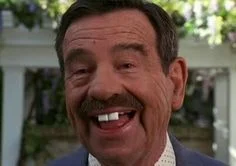
Learn more today!
We’ll take great care of you and help you to get the smile of your dreams! 573.635.6080
P.S. Don’t forget—Riverbend Dental Wellness Members get promotional pricing on in-house professional whitening ANY TIME!

Happy new year to State of Missouri employees--we're in-network!
Metlife’s policy for State of Missouri workers should make for a very happy 2019!
If you aren’t a State of Missouri employee, I’m sure you know someone who is! There are some major changes in benefits for 2019! Although, we can’t speak to the medical plan changes, we know ALL about the dental!
We’re excited to announce we will be in-network with the State of Missouri’s new dental plan in 2019.
Goodbye, Delta. Hello, Metlife!

What does that mean for employees under the Missouri Consolidated Health Care Plan (MCHP)? We’ve asked a lot of questions so you don’t have to! If you need more clarification, please be sure to reach out to your HR representative or contact Metlife Dental directly.
What you need to know about MCHCP’s Metlife Dental Plan:
Increased annual maximum to $2,000! (Previously, $1,000 - check out our post on the antiquated amount here.) This is a major plus for everyone! Oftentimes, high maximum plans mean the policy has terrible coverage, so there’s no way you’ll ever reach the max, but we don’t believe this is the case for this Metlife policy, read on:
Everything else should stay the SAME! That means 2 fully covered healthy mouth cleanings, annual x-ray images, two exams, plus 80% coverage on basic services (fillings, simple extractions) and 50% coverage on major services (crowns, anything surgical, deep cleanings).
There still will not be any orthodontic coverage on this plan, as there wasn’t on Delta either.
There will NOT be a new one-year waiting period. If you are beyond the wait period, you’re fine. If you are in the midst of the one-year waiting period (usually always enacted when you sign up for a new policy under a new job), then you will still have to complete that period before you have full benefits available.
We believe this change will be positive for everyone, fingers crossed!

We look forward to seeing you all in the new year! Thank you for letting us take care of you and your family.
Please contact us with any questions: 573.635.6080
Please note:
Unfortunately, we will NOT be in-network with ANY other Metlife plan, only the State’s policy.
We will, however, continue to be a Delta Premier provider.

The Opioid Epidemic: 115 People Die Every Day
Opioids now kill as many people as guns. (Including about 1 person every 3 months in Cole County.)
Opioids now kill as many people every year as guns.
Read on for more startling facts:
On the opioid epidemic and what exactly are opioid drugs,
Missouri and Cole County's status in the epidemic,
How your dentist and doctors are trying to prevent overdoses. (Even if it means watching an unhappy patient walk out the door.)
Finally, and most interestingly, how opioids may not even work for dental pain.

Here are some more facts on the opioid epidemic:
In 2015, about a third of all adults in America used an opioid.
It’s not a minority problem. Today’s opioid users are typically white men and women, who were first introduced through a prescription.
The majority of opioid overdose deaths are from ages 25-54.
The CDC reports opioid deaths increased 5x from 1999 to 2016, totaling 350,000+ within those years--from both prescription and illegal opioids.
66% of all drug overdoses in 2016 were from opioids. (And over half of these deaths were from LEGAL opioid prescriptions.)
So, if opioids and guns kill about the same number of people--why aren't gun deaths an epidemic? The rate of death from guns has been consistently high for a long period of time (2016 = 106 gun deaths/day), however, opioid deaths have EXPLODED, especially in the last 8 years.

The most common drugs involved in prescription opioid overdose deaths include: Methadone, Oxycodone (such as OxyContin®), and Hydrocodone (such as Vicodin®). The most common illegal opioids are heroin and illicitly manufactured fentanyl (IMF).
The first wave of deaths began in the 1990s from the increased prescription of opioids, followed by a second wave in 2010 with deaths from heroin, and finally a third wave beginning in 2013 from synthetic opioids like IMF often combined with heroin and cocaine:

Missouri (one of the top 20 worst states for opioid deaths) saw a statistically significant increase in opioid deaths from 2015 to 2016—a 30% increase! The rest of the red-coded states on this map also saw a statistically significant increase that year:

Interestingly, every state except Missouri has prescription drug monitoring system.
(Say whaaaaaat?) I know. So that means Missouri doctors can't easily look up prescriptions patients may have received from other sources. Doctors have to rely on their gut and believe the patient about their prescription history. (At least at the time of this post!)

state capitol building - Jefferson city, mo
Cole County is looking for a fight.
As of the summer of 2018, Cole County is trying to join several other Missouri counties in a lawsuit against “contributors of opioid-addiction crisis.” If there is a settlement, it could go toward education, prevention, and treatment.
According to data from 2013-2017, about every three months somebody dies from an opioid overdose in Cole County. And approximately 6 people per month in our county seek emergency treatment due to opioids. (Mainly ages 25-34!)
The Doctor’s Role in the Epidemic:
“First, Do No Harm”
An interesting paper, under this name (click above for the full document), was published last year by the National Academy of Medicine (NAM). A lengthy 21 pages written to guide medical professionals through balancing two sides of the same coin— helping people and hurting them, all with the use of opioids. Much of the information in this post is courtesy of the paper by NAM.
Regulations of these medicines is essential to ensure the health and safety of the general public, while still ensuring that their medical needs are met. --Ethan Siegel
Although saving a person’s life from opioids should be the responsibility of that person, the burden is now falling upon the shoulders of medical professionals.

Can't win them all.
It's story time: We recently lost a new patient because it isn’t our standard of care to prescribe narcotics for pain management of fillings. For FILLINGS that had not even happened yet. The patient said that their last dentist, "did it all the time."
First, narcotics are usually ever necessary for standard fillings. Even a typical extraction does not warrant a pain prescription every time.
Second, maybe their previous dentist DID do it all the time, however, dentists (and "real" doctors) everywhere are under pressure to save lives by not prescribing unnecessary opioids.
Third, if a patient gets so upset about not receiving a pain prescription (especially if they are accustomed to receiving one), it seems glaringly obvious they are exhibiting drug-seeking behavior.
We stand by our decision, wouldn’t you?

Did you know— Opioids may not even be as effective for managing short-term dental pain as over-the-counter options?
For that reason, and to hopefully help curb the overdose epidemic from abuse of opioid drugs, groups such as NAM are encouraging dentists to prioritize the use of non-opioid analgesics (pain relievers) after procedures.
Read our last Riverbend & Beyond post for more information on how to manage short-term dental pain without a prescription: click here!
Help end the opioid epidemic.
Other tips to take action against the opioid epidemic and keeping your family safe:
https://drugfree.org/article/action-plan-in-the-face-of-the-opioid-epidemic/
http://www.heroinhitshome.com/get-involved/
Jefferson City’s Council for Drug Free Youth: https://www.jccdfy.org/
List of Rehabilitation Centers in Cole County, Missouri: https://www.addicted.org/directory/category/cole-county.html

Dental Pain Management and Dental Infections
Proven ways to help dental pain without a prescription.
We’ve all been there…
It’s the weekend and you have a toothache.
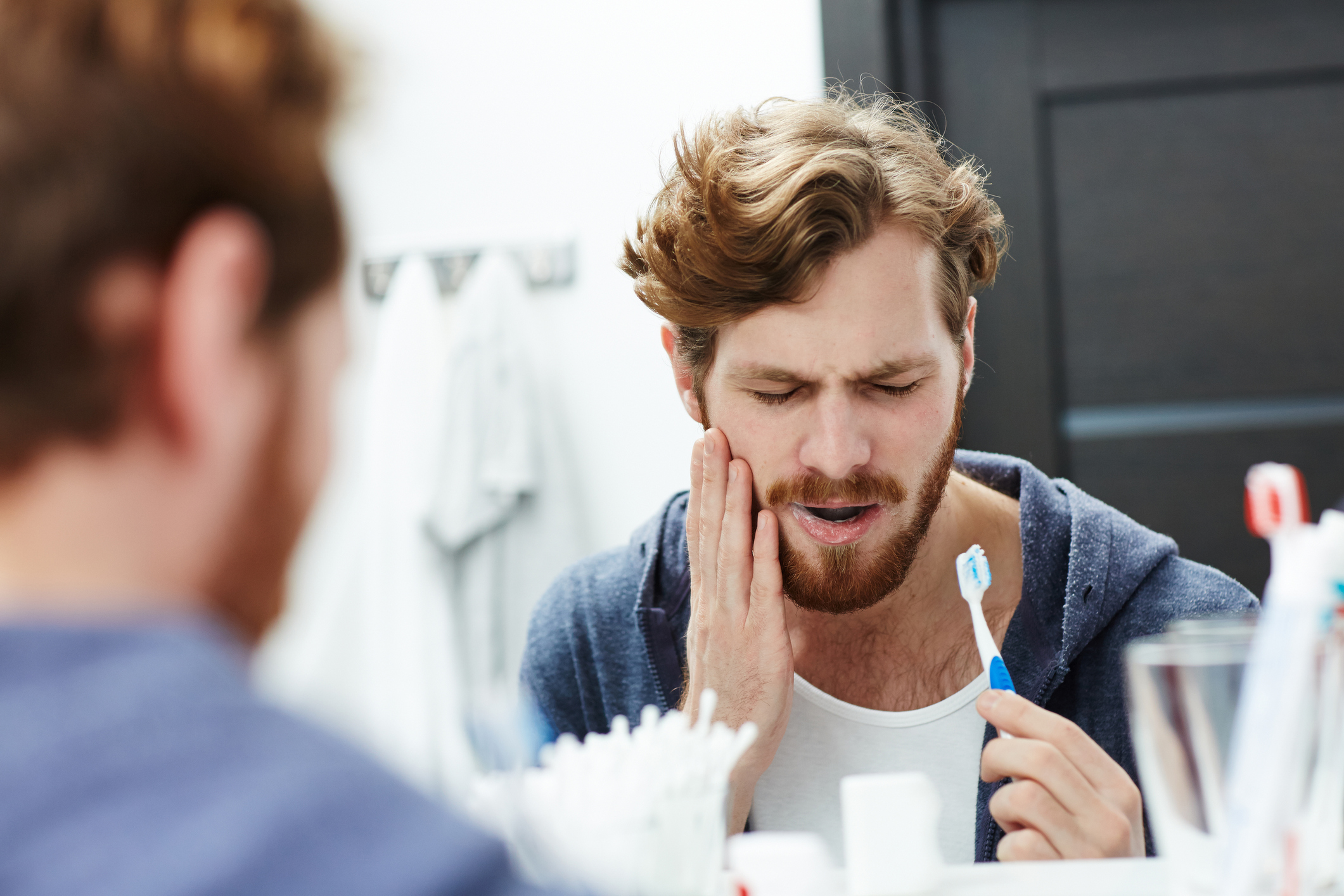
Photo by shironosov/iStock / Getty Images
We know this kind of pain can be just dull and annoying or so bad it will bring you to your knees, making you consider YouTube for at-home dentistry. (Please, don’t.)
Maybe you’ve neglected going to your dentist for a few years. Maybe you had dental work that day and you’re still needing some relief.
Don’t count on a prescription narcotic to be the only solution.
Studies show how effective over-the-counter medications can be for dental pain and how not effective some prescription pain medications can be.
Getting a call from any dentist after-hours may prove to be difficult, especially on holidays.
Not to mention, let’s remember the raging opioid epidemic in this country.
For these reasons, many dentists and doctors aren’t so quick to bust out the prescription pad for acute pain management. Even the American Dental Association (ADA) is in support of safely using over-the-counter (OTC) remedies for managing dental pain. Before we jump into how to get some relief…. there are a few important things to remember:
Dental infections are serious.
Bacteria can move OUT of the tooth and IN to the nearby bone or tissue, causing a dental abscess and can lead to sepsis (the body’s often deadly response to infection.)
People often see their teeth as individual, disposable parts of their body, they’re actually fully linked to your whole body and can affect several systemic diseases!

If you have a dental infection…
Clove oil isn’t going to help, y’all. Salt water rinses and tea bags won’t either. And for the love of goodness, do not let an Aspirin (an acid) sit on your tooth or gums.
You need the help of a dental professional.
Other things to keep in mind:
In the case of a dental infection, pain medication and even antibiotics are only short-term solutions. You MUST seek dental treatment to fix the source of the infection.
If you have swelling in your mouth or jaw, especially near your airway, you should seek emergency care immediately. This is nothing to mess around with.
Kids often can’t describe dental pain, so especially after an injury to the mouth or teeth, watch for pimples (infection) to form on the gums. Even if it is a baby tooth.
When obtaining an emergency evaluation at a dental office, don’t be surprised if you’re turned away. Many dentists won’t see new patients for something like this, only established patients. (One of many reasons it’s good to have an established dental home.) If you do get an appointment, expect to wait. You’ll be worked in around patients who have reserved appointments.
Also, the dentist will only look at that one tooth. If you want a full mouth exam, be sure to specify this when scheduling.
If you felt pain (couldn’t sleep or couldn’t eat), then it “went away”, that’s not necessarily a good sign. Often, that’s a sign that the tooth may be dying. You may need a root canal treatment in order to save the tooth at this point.
Emergency rooms and urgent care may prescribe antibiotics or even pain medication, but they typically will not treat any dental condition (unless the facility is linked to a dental school or dental residency program.) That’s a large copay for possibly no long-term solution.
Don’t have the funds to treat a dental emergency? (Remember, regular dental check-ups can find problems early, before they’re expensive and painful.)
Be sure to check out financing options such as CareCredit, which often has no interest repayment options. There are many patient financing options out there so ask your dental office what they recommend.
Don’t expect a dental office, especially one you do not have an existing relationship with, to loan you the funds for care. They aren’t a bank and don’t receive grants and subsidies for financial assistance. You may need to seek out the closest dental school or community health center, who can provide financial assistance.
Now, back to managing acute dental pain without a prescription:
Every three hours you would take Ibuprofen or Tylenol, rotating between recommended dosing of each.

Remember, dental care isn’t expensive. Neglect is. Now go reserve your next dental appointment!

No matter where you are on your journey to a healthy mouth, we’re happy to help: 573.635.6080
Check out these links for more information on OTC management of dental pain:
“Non-prescription (OTC) oral analgesics for acute pain - an overview of Cochrane reviews”
“Benefits and harms associated with analgesic medications used in the management of acute dental pain”
Dental Insurance Hacks - Dental Emergency Evaluation: Limited Exam and PA x-ray image:
Many policies will cover two exams per year, they do not care if they are emergency dental exams, new patient exams, or check-up exams. Some policies require six months between any two exams or it will be denied, others only care about the frequency limit for the policy year.
Often times a single x-ray image may be performed, this is usually applied to your deductible per your insurance policy.
If you’re self-pay and the doctor has time for a full mouth (“comprehensive”) exam, it is worth a little extra money for the comprehensive exam so you can get a list of all of your dental concerns and not have to re-pay the emergency exam fee each time you go in. A comprehensive exam is only good for so long, so be sure to schedule the care you need as soon as you can. (Don’t forget to check our our Dental Wellness Membership, where you get one free emergency exam and x-ray, plus discounts on other care!)


8 Reasons Why You May Need A Crown
And why they’re one of the easiest dental procedures for patients.
You deserve a crown!
(A dental crown, that is.)
A dental crown is a tooth-shaped cover that is placed over a broken/cracked tooth or to fix a large cavity when a filling will no longer suffice. It makes a tooth strong and healthy again and will hopefully protect your natural tooth for many years.
Read on to learn about crowns and the top 8 reasons why you may need one.
Dental crowns allow you to keep your own teeth.
I'm sure you want to keep your natural teeth and a crown is one of the most common restorations to help you to do just that. Technology for crowns has come a long way. It is typically a pain-free procedure with little to no recovery time. Here at Riverbend Dentistry, we reserve special appointment times for crowns so they are available usually within a few days... because if your tooth breaks, treatment can't wait very long. Saving a tooth with a crown can help you to avoid extractions and then possibly an implant/bridge/or a partial denture.

Photo courtesy of oral answers
Did you know our crowns are hand-painted?
Yep, by dental lab technicians, who we trust dearly! Each permanent crown is custom-made just for you. Crowns are provided in two appointments: at the first appointment we will "prep" the tooth and place a temporary crown, the second appointment a few weeks later is when you'll receive your permanent crown.
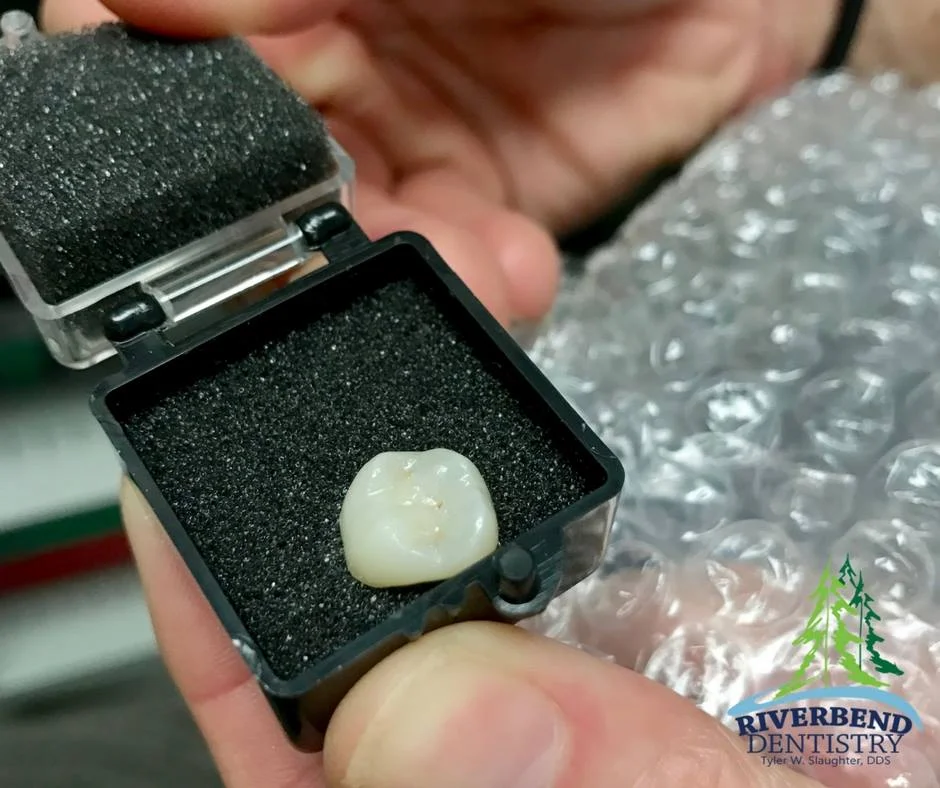
The 8 most common reasons that you may need a dental crown are:
• To cover and protect a tooth that has been weakened, usually due to decay.
• To stabilize sections of a cracked tooth.
• For broken tooth repair.
• To repair a tooth that has been severely worn down.
• To cover and strengthen a tooth where there is a large filling and very little tooth structure remaining.
• To reinforce a tooth that has had a root canal.
• To anchor a dental bridge in place (or finish a dental implant).
• To repair misshaped or severely discolored teeth.
Dental Insurance Hack: Crowns are typically covered at 50% (rarely 80%) on most dental plans up to your annual maximum and after your deductible. Be aware, many plans require the patient to have the insurance for at least a year for "major" coverage, which includes crowns!
Dr. Slaughter does PHENOMENAL crown work! (From one crown, to over ten!)

A multiple crown case by Dr. Slaughter:
If you KNOW you need that crown, or you suspect you might, give our Treatment Coordinator, Amanda, a call today: 573.635.6080
Until I need my next dental crown (I'm two in),
I'll dream about floral crowns instead.

-kim
DISCLAIMER: You should always call your insurance company or HR representative to find out the details of your insurance policy.
![Insurance 101: How Does Dental Insurance Work? [The $1,000 maximum]](https://images.squarespace-cdn.com/content/v1/5a678f3849fc2b39f2ceea93/1535475608798-H18SW91ICA9RK2KFB0YK/blog+-+welcome%281%29.png)
Insurance 101: How Does Dental Insurance Work? [The $1,000 maximum]
Let’s start at the beginning. Get ready for some shocking information!
Whether you're new to our practice or have been a valued patient for years, you may have questions about your dental insurance. This is the first post in a series covering many aspects of dental insurance--today, I'll blow your mind with where it all began and what it is like in 2018. I guarantee you'll learn something! (And maybe even get a little upset.)
Most dental benefit plans are offered thanks to a contract between your employer and an insurance company/union/association. Some person with your employer negotiates the terms of your insurance plan and they make the final decision on maximum levels of reimbursement and other details of your policy.
Unlike medical insurance, which started pre-1900...
Dental insurance is relatively new.
The concept of dental insurance was started in the 1950s and was widely available by the '70s. Most plans at that time were offered by who else but Delta Dental!
Even back then, dental insurance plan basics were typically:
$1,000 maximum, $50 deductible, 100% preventative covered, 80% coverage for basic (ex-fillings), 50% coverage for major (ex-crowns)
Guess what we have today, decades later? Copy and paste from above. No, really, it's the same for most patients with today's dental insurance.
Can you believe that dental insurance coverage amounts haven't changed much in over four decades, if not longer?
$1,000 in 1970 should give you the purchasing power of OVER $6,000 in 2017 dollars! $1,000 back then definitely would cover all dental care needed by most people, which is not the story in 2018. (Dental offices are even encouraged to call your benefits a "deposit" and not your "insurance", for this reason.)
It is documented that maximum levels of dental insurance have typically not increased at the rate of inflation since the late 1960s! Premiums (monthly fees to have insurance) keep going up for you and your employer but your coverage is stagnant or even worse with increasing restrictions by the insurance companies. Shocking, no?
"Are you in-network with our insurance company?"
This is probably one of the most common questions we receive via email or phone. "In-network" means a dental office is contracted with an insurance company and thus required to discount their fees. (Learn more about dental insurance terminology in our next Insurance 101 post!)
Newer insurance plans are offering lower and lower fees to contracted dentists so many dentists have to drop that contract--unable to run a business, take care of employees, support their communities, and more with low reimbursement. Low reimbursement means some dental offices often have to see many more patients to make ends meet.
Choosing your dental care provider shouldn't be dictated by your insurance company.
The great thing is that for most patients with dental insurance, you don't have to stay "in-network"! (Call your HR representative or insurance company to make sure you have out-of-network benefits.) Most of our patients with insurance are out-of-network. Dental offices who are out-of-network COULD ask patients to pay in full at the time of service and be reimbursed directly by their insurance company. We don't require that! We will ask for your estimated deductible and coinsurance at the time of service, send the rest to insurance to see what shakes out; if there is a balance we will send a statement. [To see who we are in-network with, click here or give us a call: 573.635.6080.]
I KNOW you learned something today! If you are fired up to make changes, we encourage you to speak with your employer or their HR department. There are many insurance companies and even plans within the same insurance company to choose from! If you are thanking your lucky starrs for a generous dental insurance plan--be sure to thank your employer today!
In the mean time, here's a little 1960s/70s wallpaper to help take us back to a time where $6,000+ in dentistry coverage was a real thing:

If you decide your dental insurance isn't meeting your needs and you'd like to consider another option, we have a great Dental Wellness Membership program. It isn't insurance and you are not eligible if you have dental insurance, but it can help you to get the care you need today without maximums and other restrictions.
Peace out!
Coming up next in the Dental Insurance 101 series: understanding your explanation of benefits and basic insurance terminology!
DISCLAIMER: If you have questions about your dental insurance plan, we recommend you always contact your insurance provider or your human resources department.

& Beyond....?
What’s this “& Beyond” stuff about….
Hello and WELCOME to Riverbend & Beyond! A little place on the interwebz where the team of Rivberbend Dentistry will share some tidbits with you, whether you are part of the Riverbend family or not (yet)!
& Beyond...?
Well, we work with teeth, on teeth, removing teeth, replacing teeth, talk teeth ALL DAY LONG. If we wouldn't want to read about teeth all the time, we doubt you would either. And since we believe so strongly in community involvement and support, "& Beyond" leaves the door open for us to talk about whatever we want around town. Don't be surprised if you see our new favorite restaurant in Jefferson City featured and guest blog posts from some of our favorite people and patients, maybe even what's on our podcast list lately.
We decided to start a blog with the launch of our new website as a way to connect and EDUCATE! And just have some fun sharing some of the things that make us happy.
A little taste...
Oral health linked to systemic diseases (in other words, how gum disease affects your heart health, diabetes, and more),
Behind the scenes at Riverbend Dentistry,
Inspiration to reach your optimal health,
Information about kids' oral health,
Services offered at Riverbend,
Featured patients,
Featured specialists,
Case studies from our patients,
New oral health-related research,
Dental products (including junk I know you've seen on Instagram or Facebook),
And so much more. (As I mentioned, expect some non-teeth talk too.)
If you have a Riverbend & Beyond blog idea or would like to be featured, please email us at riverbenddentistry@gmail.com.
We can't wait to get started!